Condition monitoring for CNC spindles
A spindle bearing does not fail overnight. It gives warning.
Long before a bearing becomes audible, its vibration pattern changes. We measure that change on every spindle, compare it with the machine's learned baseline, i.e. the normal state of this spindle, and tell you what has changed. Across manufacturers and without writing to your CNC control.
- CNC controls
- SINUMERIK · TNCSiemens and Heidenhain in one view. FANUC to follow.
- Access
- Read-onlyNo write function in the code. Four independent safeguards.
- Damage types assessed
- 5 damage patternsOuter race, inner race, rolling element, cage, unbalance.
- Data location
- GermanyProcessing and storage exclusively in data centres in Germany.
How it works
Three steps. No intervention in your machine.
In plain words for managing directors and plant managers. The technical details are under Product.
- MeasureA vibration sensor sits on the spindle housing, a small edge box on the machine. The box reads from the CNC control how fast the spindle is turning. It changes nothing on your machine.
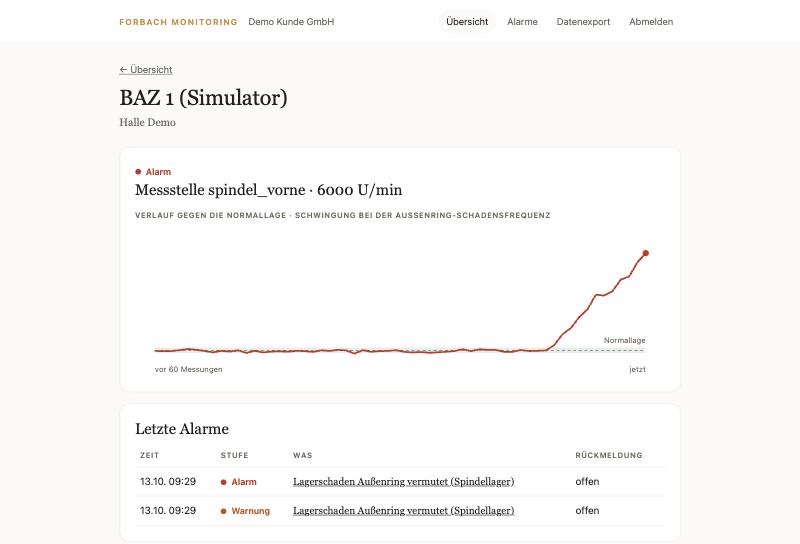
- CompareThe software learns how your healthy spindle vibrates and compares every new measurement with that. An incipient bearing defect changes the vibration pattern long before it becomes audible.
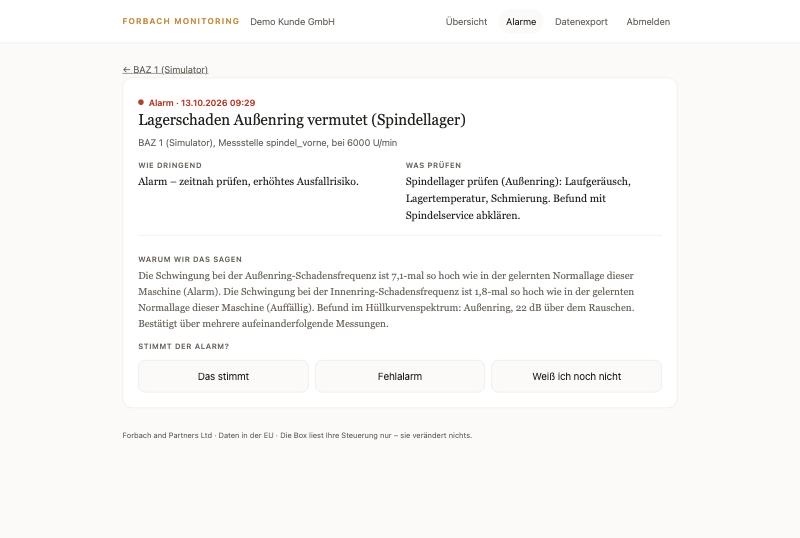
- AlertIf something deviates, your maintenance team receives an alert in plain language: which component is affected, how urgent it is and what to check.
Plan instead of react
The bearing replacement goes into the next maintenance window instead of landing in the middle of an order.
Meet delivery dates
Less unplanned downtime means fewer rescheduled jobs, rush orders and extra shifts.
Avoid consequential damage
Bearing damage detected early costs a bearing. Detected late, it can cost the spindle, the tool and the workpiece.
Scope
Today the spindle. The rest follows once it works.
This page only describes what the system can do today. Anything still in development is marked as such. That way the pilot holds no surprises.
Spindle and spindle bearings
AvailableVibration measurement on the spindle housing, analysed with envelope analysis. This is the established method for early detection of rolling bearing damage. The comparison is always against the learned baseline of your spindle, not against someone else's average.
Feed axes and ball screws
In developmentFollowing error and load profiles to detect friction and backlash. Recorded during the pilot, but not yet assessed.
Automatic tool changer and coolant
PlannedOn our roadmap. Not part of the offer today.
Method
Explainable, not a black box.
Maintenance engineers will not stop a machine because an algorithm has a bad feeling. They want to know which value has changed and how. That is why every alert shows its reasoning.
Measure
A vibration sensor on the spindle housing, plus speed and, where available, load from the CNC control via OPC UA.
Learn the baseline
Every spindle vibrates differently. The system first learns how your machine sounds in a healthy state.
Assess the deviation
Features at the damage frequencies are checked against the learned baseline. What counts is the trend, not a single value.
Alert with reasoning
You see the feature, the damage pattern and the size of the deviation. With your feedback we calibrate the thresholds for your machine.
We deliberately do not predict failure to the day. Nobody can do that credibly.
Data security
Your IT can decide in ten minutes.
We document which data leaves your plant, over which port and in which direction. The edge box does not capture NC programs, drawings or operator data.
- ANo write functionThe software contains no code that writes to a CNC control.
- BUpstream blockAny request that would change something is blocked before it reaches the CNC control.
- CAutomated checksTests ensure with every change that no write path is introduced.
- DRead-only userA dedicated user with read rights only, for SINUMERIK for example SinuReadAll and AlarmRead.
| Direction | Port | Purpose |
|---|---|---|
| Box → CNC control | 4840 · OPC UA | Read, encrypted (Basic256Sha256) |
| Box → platform | 8883 · MQTT/TLS | Send features, otherwise 443 |
| Box → update server | 443 · HTTPS | Fetch signed updates |
| Outside → box | none | No inbound connection possible |
If your firewall uses TLS inspection, the box needs an exception. Otherwise mutual certificate validation fails. Pass this sentence to your IT and the matter is settled.
Downtime calculator
What does unplanned downtime cost you today?
For management: in one minute you can see what unplanned spindle failures cost your business per year, per month and per working day. With your own figures; we do not insert a savings rate. Open the calculator with explanations
Process
We show you on your own machine.
- 20 minutesIntroductory callWe establish whether your CNC controls can be connected. If not, we tell you.
- By emailPreliminary checkNameplate, software version and OPC UA options for each machine. Your IT receives the security datasheet.
- One day on siteConnectionRead-only access, measuring points on the spindle housing, connection test. Production keeps running.
- OngoingPilotLearning the baseline, alerts with reasoning, a monthly report for each machine.
Your contact

Sascha P. Forbach
Founder, managing director and software architect · Düsseldorf
“German industry does not win on price. It wins when its machines run when they have to.”
We are launching on the market and taking on our first manufacturing customers. In the introductory call you speak to the founder, not a call centre.
Next step